

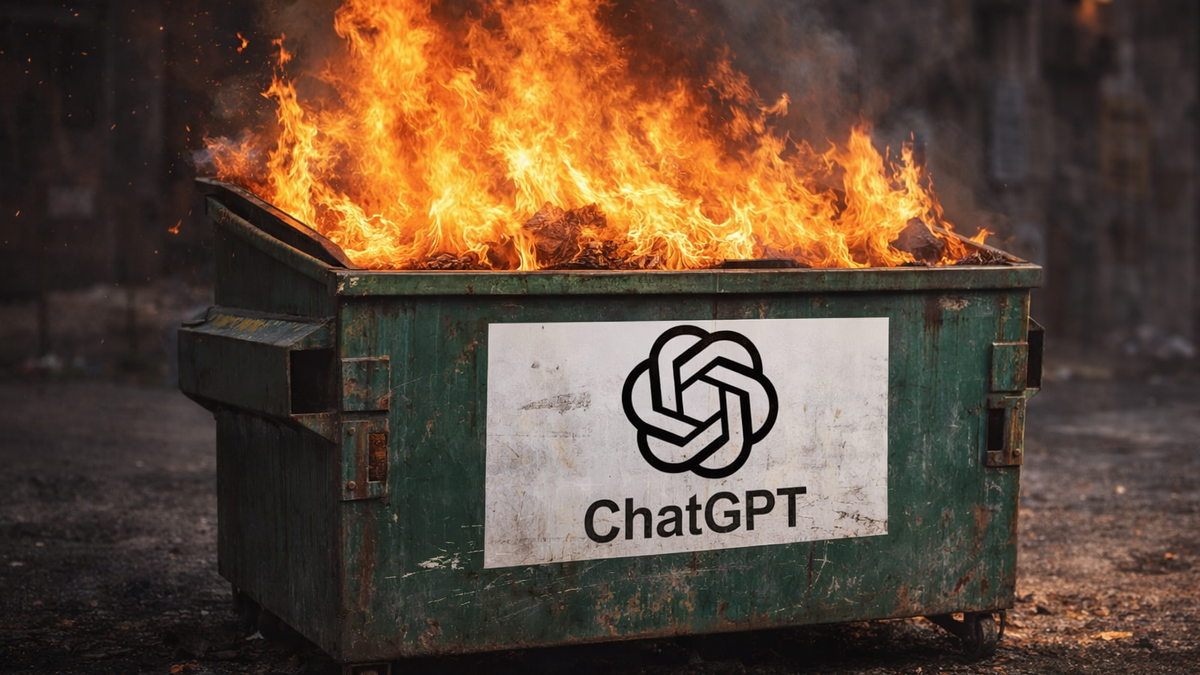
OpenAI has achieved a significant milestone that many startups can only aspire to: over $20 billion in annual recurring revenue. Reports indicate the company grew its income impressively in a mere two years. Yet, despite this growth, ChatGPT, a popular AI tool that appears to know everything, struggles to turn a profit. The financial challenges facing the AI industry appear to be undermining its profitability. For every dollar OpenAI brings in, it appears to spend significantly more on the computing power required to generate those answers.

Image credit: Shutterstock
The financial paradox of OpenAI is that its growth does not currently align with sustainability. Unlike traditional software companies that can enjoy high margins once a program is written, selling it to a million more people costs almost nothing. AI behaves differently.
Every time a user says something as simple as "please" and "thank you", OpenAI has to pay for the electricity and computing power required to generate a response, as Sam Altman said, "tens of millions of dollars well spent--you never know."
The cost of intelligence
Recent disclosures indicate that OpenAI's compute capacity required 1.9 gigawatts of electricity, a consumption that could supply millions of homes. While revenue reached $20 billion in 2025, George Noble, a veteran hedge fund manager, had previously indicated that the company had lost $12 billion in a single quarter. These figures imply that the company is effectively subsidizing global AI use with investor capital from partners such as Microsoft and SoftBank.
The primary issue is the "burn rate", leading to a cost of about $15 million per day on the usage of Sora alone, a text-to-video model. While $20 billion in revenue looks like a good figure on the surface, OpenAI needs to generate at least $200 billion in annual revenue to justify its projections.
The revenue strategy challenge
Sam Altman has historically been hesitant about traditional monetization, once calling advertising a "last resort". However, the increasing costs have prompted a change in strategy. In January 2026, OpenAI confirmed it would begin testing ads within the free version of ChatGPT and a new "Go" plan. Instead of relying solely on $20 monthly subscriptions, the company is now implementing a multi-tiered approach.
This includes maintaining the Plus and Pro plans for heavy users while expanding enterprise deals, which already involve over one million companies paying for corporate versions of the tool. Additionally, OpenAI is moving to monetize the hundreds of millions of free users through advertising and charging other developers API fees to build their own tools on the platform.
The goal is to reach what CFO Sarah Friar calls "practical adoption". This means ensuring that people, businesses, and countries effectively leverage AI's benefits in their everyday lives. There is a significant and urgent opportunity, especially in areas such as health, science, and business, where improved intelligence can lead to better outcomes.
The competition and the "Stargate" project
OpenAI isn't the only player in the game when it comes to creating advanced technology. Google has a significant edge because it owns its own data centers and has a built-in revenue stream from advertising.
To compete, OpenAI is involved in the "Stargate project", which aims to invest $500 billion over the next four years to build new AI infrastructures. The gamble is that building the most powerful AI in the world will eventually make the sheer utility so high that the costs become secondary. However, some analysts question the long-term viability. If the cost of running these models does not drop significantly, OpenAI could find itself in a permanent loop of needing more cash. There are even warnings that the company could face insolvency in the coming years if another massive round of funding is not secured.
Why this matters
The financial struggle within OpenAI is a signal for the future of the entire digital economy. If a leading company in artificial intelligence struggles to manage its costs, we might see the end of the free and open access that many people have enjoyed. We are already seeing the beginning of this transition as free, unlimited access is replaced by tiered subscriptions and the introduction of advertising. This indicates that AI might not develop in the same way the early internet did, which was largely free to the public, but instead become a premium utility accessible mainly to those with the capital to pay for it.
Additionally, the future of AI depends on continued support from major investors. If the projected losses materialize without a clear path to profitability, the industry could face a significant contraction. This would slow down innovation and limit the tools available for medicine, research, and education. Leadership's decisions today on monetization will set the standard for every other AI startup.
Ultimately, the ability to balance the books will determine if AI becomes a universal tool for everyone or a restricted luxury for the few.




 English (US) ·
