

The low rate of AI adoption in the workplace may not be due to lack of trying, but lack of dedicated training.
Last June, roughly 70 Microsoft engineers stopped working for a week and gathered in person to discuss workflow, friction points, and what an AI-first team looks like. They even covered the professional identity crisis of developers, who once spent days writing code and now manage bots that do it for them.
“They come away as real evangelists,” said Katy George, Microsoft’s corporate vice president of workforce transformation.
The developers returned to their normal jobs but intentionally worked at a slower pace during the next two weeks, aiming to practice their AI learnings and form new habits in their work. They continued virtual training sessions on Microsoft’s specific AI tools and how to build custom agents, and participated in a hackathon.
Starting in January, Microsoft began expanding this initiative, called “Camp AIR,” first to human resources workers, with plans to implement it across the entire company. The three-week boot camp is Microsoft’s bid to make employees more efficient using the latest AI, without leaving them to experiment on their own.
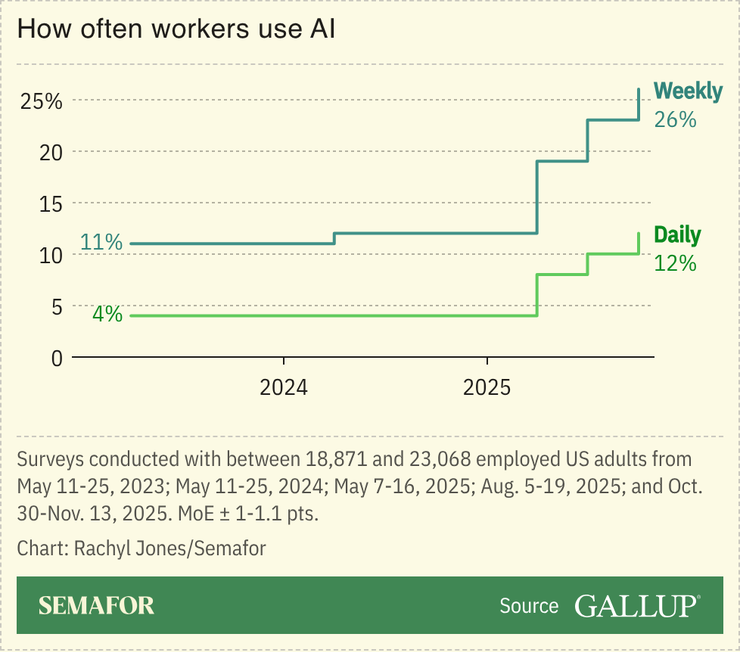
AI adoption is something many companies, even in tech, struggle with when there’s no clear roadmap for training workers, free time for employees to play with tools is limited, and many fear AI will eventually replace their jobs. The existence of a program at Microsoft indicates that even employees leading the AI charge need guidance on integrating it into the workplace and clarity about what AI-driven changes mean. It also suggests that overall business transformation promised by executives could take longer than expected. While AI adoption is rising across US workplaces, it’s doing so slowly. Daily usage is up from 4% in 2023 to 12% at the end of 2025, according to a Gallup survey. Even tech workers aren’t fully on board, with just less than one-third using AI on a daily basis.





 English (US) ·
