


Published Feb 19, 2026, 6:00 AM EST
Jon has been an author at Android Police since 2021. He primarily writes features and editorials covering the latest Android news, but occasionally reviews hardware and Android apps. His favorite Android device was the Pixel 2 XL, and he regards the three months when he owned an iPhone as a time of the utmost shame. Jon graduated with a History degree in 2018, but quickly realized his writing skills were better put to use writing about tech rather than essays. He started writing and editing for startups shortly after graduating, where he did everything from writing website copy to managing and editing for a group of writers. When he's not sitting at his computer, you can find him working at Warhammer World, reading sci-fi, or turning his speakers up to 11.
I fondly remember discovering Google Docs in 2012. At the time, the idea of real-time collaboration was relatively new, so Google Docs and its fellow apps felt revolutionary.
Still, Google's apps weren't the first to offer this feature, but compared to tools like Microsoft Word or OpenOffice, it felt like the future.
Fast-forward to 2026, and the core functionality of Docs remains the same. I use it daily for personal and professional purposes in much the same way as I did a decade ago.
A significant part of what I loved about Docs was how accessible it was to anyone. No features (barring niche Workspace tools like e-signatures) were off-limits; all you needed was a Google account.
However, since Google launched Gemini, it has begun partitioning Docs and its fellow apps into a fractured landscape of free and paid features.
I still use these apps, but how long before a Gemini Pro subscription becomes the only way to use them?

Related
Google is growing its apps behind a paywall
Apps like Google Docs are starting to feel fractured and incomplete for free users
 Credit: Google
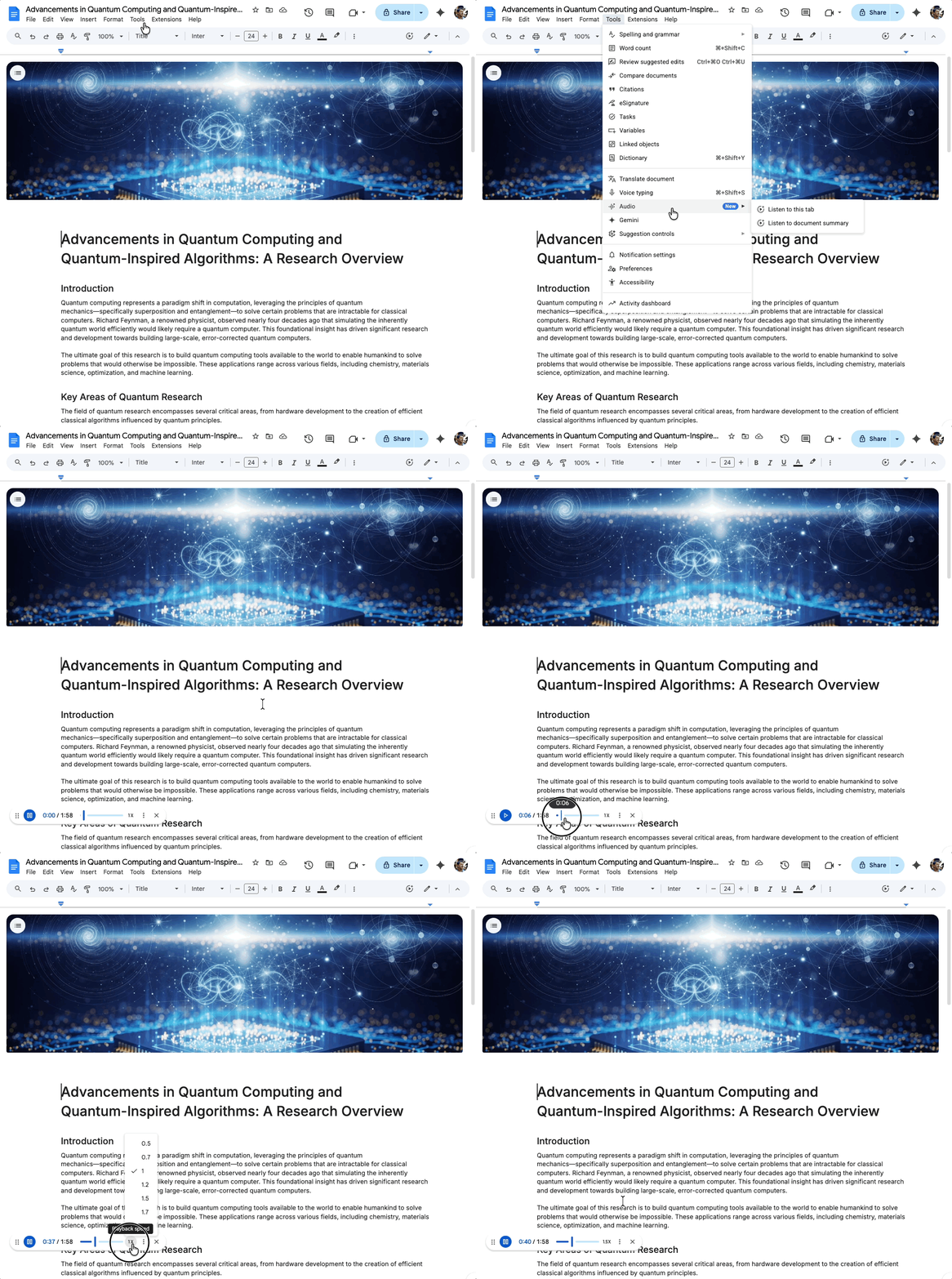
On February 12, 2026, Google announced a new Gemini-powered feature for Google Docs. This tool, appropriately named Audio Summaries, provides a short verbal synopsis of a document.
AI-powered summaries have been around for years; this is a natural evolution of a feature we've become used to.
Not only does Audio Summaries summarize documents for you, but it also lets you personalize them with different voices and playback speeds.
It's a useful feature, but before you switch to Google Docs to test it out, check if you're paying for the privilege first.
Audio Summaries are currently only for the following plans:
- Business Standard and Plus
- Enterprise Standard and Plus
- Google AI Ultra for Business add-on
- Google AI Pro for Education add-on
- Google AI Pro and Ultra
Google AI Pro, the only tier here for everyday users, costs a whopping $19.99 a month. However, you get a lot more than just Audio Summaries.
Within Docs, you can have Gemini write new text, rewrite existing texts, generate audio, collaborate, and more.
On top of the rest of the benefits, it's a hefty suite of features, but they're all locked behind a paywall.
This might not seem like a big deal if you don't use Gemini. After all, I've ignored all these features in my personal life, and I haven't noticed them interfering with my work.
Nevertheless, the rate at which Google is launching new features behind a paywall makes me wonder if the era of accessible Google Docs is at an end.
Might Google's office suite go the same way as YouTube?
Google has turned YouTube Premium into a necessary subscription

Using YouTube in 2026 without a Premium subscription is an aggravating experience. Five-minute ads are common, and good luck trying to play videos in the background thanks to Google's latest crackdown.
Google is steadily making the free YouTube and YouTube Music experience worse to push people towards Premium. This is problematic, but at the end of the day, YouTube isn't vital to our everyday lives.
Google's office suite is a completely different story. I've become so reliant on it for all aspects of my life that if Google were to force me to pay for it, I would have little choice but to do so until I found alternatives.
I don't think Google will ever lock the entire Google Docs Editors suite behind a paywall, but I do think it might devalue the core service just like YouTube.
Google Docs and its kin are far more usable in their free tier than YouTube. But as Google releases more and more features behind a paywall, I no longer take the tools I use daily for granted.
How long before Google imposes limits on how people can collaborate? What about offline availability? Templates? Translation tools? Advanced formatting?
These are all tools Google could lock behind a paywall without making the core product unusable. Sure, it might seem far-fetched, but remember how great YouTube was before Premium?
What happens when we're too reliant on apps to abandon them?
Google can force us to pay if it knows we can't leave

Think about all the apps and websites you use daily. Most are free, right? Perhaps you pay for ChatGPT or a Proton VPN subscription, but these paid apps form a tiny proportion of the apps we use every day.
However, I know that I'm paying for more apps than ever. It seems like every app is trying to push us towards a "small" monthly subscription, which adds up quickly.
This is fine for entertainment apps, but what about for apps we need to use?
I've already started looking at alternatives for Google Docs, just in case. I recognize Google's need for money, but as its tools become more and more embedded in our daily lives, it's easy to see how Google could start to extract revenue just because we're too locked in to abandon them.
Don't take features and apps for granted
As Google leans more and more on AI, the apps and features we've taken for granted for more than a decade are in danger.
Yes, new features and tools arrive for free, but the sense that Google is focusing on winning us over with paid AI subscriptions is stronger than ever.
It's fine for now, but how long will it be before we're paying for tools, not because they're good value, but because the free versions are so much worse?



 English (US) ·
