

You’re probably reading this article too close to your face ― and it might be why your eyes and head hurt.
That’s because “the closer that you hold something, the more that you’re using those muscles inside of the eye to try to keep it clear” to see, said Dr. Benjamin Bert, an ophthalmologist and assistant professor at the Doheny Eye Center in the University of California, Los Angeles.
And so many of us are guilty of jamming our phones as close as possible to our faces. I sometimes scroll until my eyes are screaming for a break.
But there is one built-in iOS tool I have found that is a helpful intervention against my bad phone habit: the underrated iPhone’s “Screen Distance” feature.
Once activated, this feature ― which has been available since the iOS 17 software update ― alerts me when my phone is less than 12 inches from my face for an extended period of time.
What’s helpful is that the alert will take over my screen and it won’t stop this reminder until I move the phone farther away. It’s this forceful intervention that has been making me more mindful when other mental reminders haven’t changed my behavior. Maybe it could for you and your family too.
Here’s why this “very helpful” feature, as Bert put it, could make a major difference in people’s eye health.
‘Screen Distance’ Can Majorly Benefit The Eyesight Of Kids And Young Adults In Particular
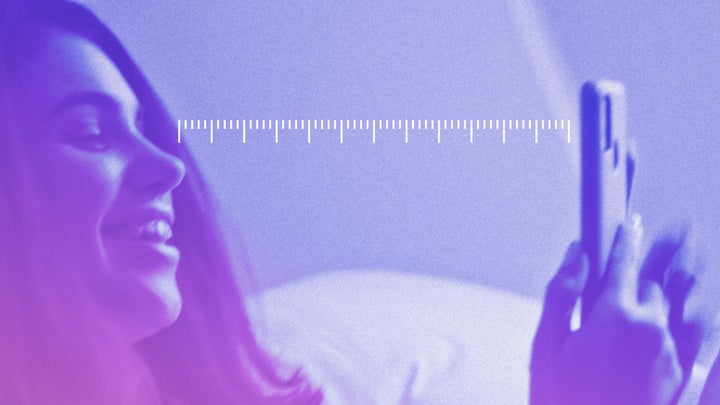
Illustration: HuffPost; Photos: Getty
Kids’ eyes are still developing as they grow up, and they are the group that might most benefit from this kind of iPhone intervention.
“One of the things that we’re seeing is kids are developing more myopia, which is more nearsightedness,” Bert said. That’s why some kind of phone warning could “reduce the rates of nearsightedness.”
That’s because the longer young kids stare at screens up close, the more likely they might be anatomically changing their eyes. One of the forms of myopia is caused by eyeballs growing longer and larger.
“The muscle that has to contract in order to focus on things up close is attached to the sclera ― the white part of the eye ― and [researchers] think that that chronic kind of flexing of that muscle can motivate the sclera to elongate and make the eye bigger,” Bert explained.
Bert suggested that in general, it would be a good idea for this kind of screen distance warning to be used by people up to the age of 18 until their eye prescription stabilizes.
“If you’re going on a big trip and you let your kid use their phone or their iPad for six hours in a row, that’s probably not going to do any harm to them,” Bert said. “But if every single day ... they’re on a screen, holding it close, and they’re doing that for six to eight hours consistently, then there’s more of a likelihood of having that kind of shift in the development of some nearsightedness.“
Adults don’t have to worry as much about ruining their eye’s development from too much up-close screen time, but this kind of practice can still be beneficial.
“For adults, it’s a little bit different, because our eyes have kind of settled. They’re going to be the size that they’re going to be. They’re not growing,” Bert said. At the same time, this habit can still “create eye strain, which can cause headaches,” he noted.
How To Turn On ‘Screen Distance’
Apple states that Screen Distance is turned on by default for children under 13 in a Family Sharing group plan, but the rest of us need to activate it intentionally.
To try this for yourself, go to Settings in your phone, then tap Screen Time. Then select Screen Distance, so you can choose to turn Screen Distance on or off.
There’s A Free Way To Protect Your Eyes Without An iPhone Too
“Screen Distance” is a helpful reminder to move your phone farther away, but you don’t need an iPhone to be more mindful about how you read and scroll on your tech devices.
Bert noted that a forearm distance of 12 inches, as the Screen Distance feature enables, is “a good starting point” for better eye health, but there are no studies that prove it is the “absolute ideal distance to maintain.”
A simple free way to protect your eyes from strain is to practice giving them a break every hour using the 20-20-20 rule.
“Every 20 minutes that you’re on a device or you’re looking at a near target, you should take 20 seconds to look at something that’s at least 20 feet away,” Bert explained. This way, the muscles inside of your eyes can “relax a little bit.” You should also close your eyes for at least two seconds, he added.
These mindful exercises help you pay attention to how your body actually feels. This way, you can notice if your eyes feel dry, heavy or strained, Bert suggested.
YourSupportMakes The Story
Your SupportFuelsOur Mission
Your SupportFuelsOur Mission
Join Those Who Make It Possible
HuffPost stands apart because we report for the people, not the powerful. Our journalism is fearless, inclusive, and unfiltered. Join the membership program and help strengthen news that puts people first.
We remain committed to providing you with the unflinching, fact-based journalism everyone deserves.
Thank you again for your support along the way. We’re truly grateful for readers like you! Your initial support helped get us here and bolstered our newsroom, which kept us strong during uncertain times. Now as we continue, we need your help more than ever. We hope you will join us once again.
We remain committed to providing you with the unflinching, fact-based journalism everyone deserves.
Thank you again for your support along the way. We’re truly grateful for readers like you! Your initial support helped get us here and bolstered our newsroom, which kept us strong during uncertain times. Now as we continue, we need your help more than ever. We hope you will join us once again.
Already contributed? Log in to hide these messages.
Ideally, we wouldn’t need our phones to protect us from our phones in the first place.
“The easiest thing to do would be to put [the phone] down and do something else ... Go outside and have physical activity, that would be the ideal,” Bert said. “But ... there’s so much information that we get from our digital devices that it’s hard to do that. So having it kind of help us, I guess, is good.“
So until we are better at controlling our own phone impulses, it helps to use all the reminders we can get to give our eyes a much-needed break.


 English (US) ·
